
RED HOT CHILI PEPPERS
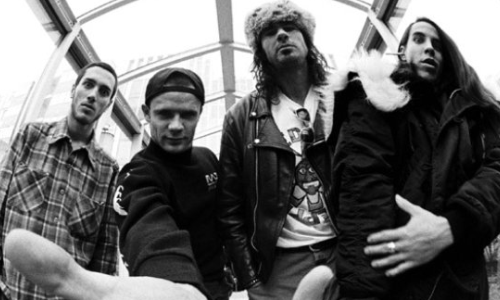
| Years active: | Genres: | Related artists: |
| 1983 - present | Alternative rock, funk rock | John Frusciante |
Line-up: We'll get to the line-up changes in more detail further down this page but it's good to provide a quick summary of everyone who ever made it onto an actual record (and not counting any interim replacements), so here we go. The unchanging core of the band consists of Anthony Kiedis (vocals) and Flea (bass, occasional vocal and trumpet). Drummers: Jack Irons (1983, then 1986-1988), Cliff Martinez (1983-1986), Chad Smith (1988 to present). Guitarists are a messier affair, starting with Hillel Slovak (1983, then after a brief break 1984-1988 until his death) and Jack Sherman in the interim period (1983-1984). John Frusciante joined in 1988, left 1992, returned 1998, left again in 2009, and returned again in 2019. In-between Frusciante going in and out the band got to record albums with Dave Navarro (1994-1997) and Josh Klinghoffer (2009-2019) on guitars.
Flint's Greater Theory of Buttrock states that no matter what kind of a big music nerd you are and how refined you reckon your tastes might be, everyone has one straightforward rock band in their music library that they bat for even if it seems contrary to their usual tastes. The jazz geek has a full Kings of Leon collection on their record shelf, the indie hipster knows every word of every song by the Foo Fighters, the underground electronic producer still loves to crack out their favourite AC/DC records when no one is around, etc. Have a look at your music collection - I bet there's some kind of a beefy rock band there you might not immediately declare your love for when hanging out with other music fans. This is all obviously extremely subjective and it's drenched in a certain kind of music elitism that most of us ought to naturally abhor, but the more you spend time around people who are similarly passionate about music as you are, the more you learn that there are certain artists that are simply automatically too uncool to like and who frequently act as a punchline for cheap jokes - but all these people cracking jokes has that one artist where they start to bend their own rules.
Red Hot Chili Peppers are my buttrock band.
How your favourite local indie dweeb get so entranced about these (in)famous Californian sex-funk-rock rowdy lads is simple - they were there right in the very beginning. Two things happened in the year 1999: the Peppers released their mega-super-smash hit album Californication, and I met new friends in school who were similarly starting to form identities as The Music Guys as we were starting to head towards our teenage years where we form our tribes. It was my best friend at the time who turned me and our other best friend into the Peppers, having already been familiar with the band through his big brother's CD collection, and the fact that this coincided with the group being absolutely everywhere with their chart-smashing latest album was simply a bit of perfect cosmic timing. Over the next couple of years our love for RHCP would become a defining factor of our personalities - we would know every lyric by heart (and my young, innocent, foreign and ultimately quite gay mind completely brushed off what exactly I was memorising at times; I knew what some of these songs were about but all these depictions of lush ladies felt so distant I barely bat an eyelid), we would talk about the songs and the albums during recess and after school, and we even formed a scrappy little band for a fleeting moment which was basically just a knock-off of early Peppers. They were also the first artist where I would actively hunt down the back catalogue, instead of simply being content with whatever album I had heard and become content with, leading me to the joys of music shop browsing as I checked the shelves excitedly for any release I didn't have yet. When I was at home by myself, my information-hungry mind would search the fancy new "internet" for any kind of information I could find about the band - those sleuthing sessions taught me for example what b-sides are, and thus started that snowball.
RHCP were an establishing institution in my life as a music geek, and for that alone they have earned a permanent place to lodge in my heart. But as is perhaps predictable, there is a cut-off point to my earnest appreciation for the band and that just so happens to coincide with the time period when my friends and I began to grow a little further apart as we started to find our own paths following our high school graduation. Sure is an incidental timing huh (the author inferred sarcastically)? But that is one reason why I'm particularly excited to have a page dedicated to RHCP on this site - because I'm also using this review project as a means to an end to dive through that discography once more, in a neat, organised and thorough manner in order to understand a little more about my modern relationship with the band's music.
But before we get into that, a brief history lesson of the band itself. Red Hot Chili Peppers were formed in 1983 by four rebellious and wild young men from California (though all but one were immigrants to the region), who had formed a deep bond of friendship in school and connected through their shared love of music. Hillel Slovak and Jack Irons were two music life-stylers who were putting most of their spare time in the band What Is This (FKA Anthym) which they had formed with their friend Alain Johannes, and which they saw as their potential means to fame. There was also Michael "Flea" Balzary, an Australian lightning ball of manic energy and a former jazz trumpeter turned bass prodigy (courtesy of Hillel who nudged him to the instrument when Anthym needed an interim bassist), who had already began to receive invites for surprisingly prestigious substitute bassist gigs fresh out of school thanks to his insane skills and unmistakeable enthusiasm. And then there was Anthony Kiedis, who may have lacked the instrumental skills his friends had but who radiated with natural charisma and a desire to entertain, and thus regularly warmed up the crowd for What Is This before the band took to the stage. But all four liked to hang out and play music together too, and one day Kiedis brought in a rap he had written on a moment's inspiration, which the crew wrote a song to go with. What would become Red Hot Chili Peppers was meant to be a simple one-off performance in lieu of the typical gig warm-up, with this ragtag band (who for this performance had called themselves Tony Flow and the Miraculously Majestic Masters of Mayhem) playing their one song with chaotic energy and then leaving the stage - and that would've been it if not for the crowd going absolutely wild and the venue owner wanting to book them again (insisting however that they should have at least two songs next time). This lead to the group - quickly renamed Red Hot Chili Peppers - continuing to perform concerts together and in the process becoming fast-rising stars in the Hollywood underground. A demo tape was recorded following an encouragement from their inner circle, and soon after this meant-to-be-one-off group had a record deal from EMI, who was busy tapping into every opportunity in the American alternative scene.
The story of RCHP from there onwards is a genuinely unpredictable and chaotic series of peaks and valleys, and the ins and outs of those will be told in more detail throughout the album reviews as that context forms a huge part of why each album turned out the way it did. You don't even need to look far: Slovak and Irons' commitment to What Is This (who had also received a record deal around this time) meant that the two men felt obliged to leave RHCP given its original nature as a casual side project, which means that the plot twists begin right from the band's very debut as they had to bring the album together without two of their key members. But there are two particularly seismic events in the band's history that are worth noting separately. One was the death of Slovak in the late 1980s to a drug overdose, which also lead to Irons leaving the band (very soon after both men had rejoined the band in the first place - we'll get to all this). Slovak's death hangs a shadow across the group's entire career long after his legacy no longer directly touched the music: both Flea and Kiedis considered Slovak something close to a soulmate and his passing was the first - but not the last - major sign that the group's drug-friendly lifestyle had a darker edge that would remain in their lives long after everyone had sobered up. The replacements for Slovak and Irons were, respectively, the young guitar wizard John Frusciante and the booming drummer giant Chad Smith, and this turned out to be the light at the end of the tunnel that Flea and Kiedis were wandering in at the time. It's this quartet line-up that would mark the Peppers' name in history. Frusciante's gift for composition and Smith's sheer prowess were a perfect counterpart for Flea's mad bass magic and Kiedis' growing range as a performer, and together they would become one of the major names of 1990s alternative rock. Frusciante on his own has had a troublesome history with the band and he's left and returned a number of times for various reasons, always leaving the band in a turmoil of some sort just for them to pick up the pieces and reinvent themselves time and time again. Frusciante's first return in 1999 is the other great milestone event of RHCP lore: following a brush with death (drugs, again), Frusciante got completely clean motivated by the love and friendship of his three former bandmates and then rejoined the group. After his resurrection/rejuvenation, Frusciante returned with a brand new, boldly melodic guitar style and an increased love for arrangement and harmonies, resulting in a real imperial phase for the band - this is when they would move from 80s cult heroes and 90s alternative hitmakers into a legitimate stadium act all over the world, with creative refreshment resulting in stupendous success. RHCP's history is littered with guitarists and (to a lesser degree) drummers, only some of which ever even made it onto a record, but it's the Kiedis/Flea/Smith/Frusciante team-up which has become their definitive one for many, if not most people (not just fans). It's telling that when Frusciante rejoined for the second time in 2019 (after he left again ten years earlier - I said we'll get to all this), there was more buzz around the band than they had had in years, solely because of that dream line-up coming back together.
This isn't really to diminish the other people who've played in the band, all who've left their mark and who have ensured that the band's long discography has broadened in range and style through circumstances. Both Martinez and even Sherman (who the band famously did not get along with) had built-up experience that taught Kiedis and Flea new tricks even as they were frustrated with the loss of Slovak and Irons, Jane's Addiction guitarist Dave Navarro's stint in the band felt like a natural evolution of where the band were heading and a right man in the right time kind of moment even if ultimatey the chemistry ran sour, and Klinghoffer... I'll get to Klinghoffer properly in the reviews for his era but his time in the band is ultimately defined by the ghost of John Frusciante hanging over his head which he couldn't escape no matter how talented he was or how much creative fresh blood he tried to bring to the band (and failed, not down to his efforts). If anything, one of the reasons RHCP have endured as a musical act is because through thick and thin, through line-up swap from another, they have always been a phenomenal set of musicians who demonstrate what kind of a spark you can get when gifted individuals are left in a room to jam. Even the people who openly dislike the band admit this almost begrudgingly: you cannot fault the sheer talent that's behind the amps and drum kits, from Flea's utterly mesmering bass expertise to Frusciante's gorgeous guitarwork. I would happily both men and Smith in particular as among my favourite musicians in their respective instruments.. As for Kiedis... well, I like him. Kiedis is by no means the world's most talented singer or, heaven forbid, lyricist - but he has found the right people in the universe to perform with, and a key reason why that one specific line-up is so successful is because of the undeniable chemistry those four men have together, Kiedis included. He has genuine charisma and in a band where all that instrumental talent could easily become a series of individual show-offs in the most clinical manner, Kiedis is the heart that roots the songs to something more human. Objectively speaking he's a bizarre vocalist whose weird voice changes, sometimes awkward rapping and bordering-on-nonsense lyrics could go southways in so many ways; but it's impossible to think about the Peppers without him. And, come on, I already said how crucial this group was in my own musical story - of course I've developed a relationship with that voice and that performance. I wouldn't have RHCP without him.
However, the question arises: how much of my appreciation for (certain parts of) the Peppers' discography is that kind of half-nostalgia / half-personal bias, and how much of it is genuine musical appreciation? The answer is... they're one and the same. I was knee-deep in the trenches of RHCP for such a long time and with such passion that even some of the most inconsequential parts of those album eras hold some form of meaning for me. That's always going to be there in the background of course, but it has helped me understand just how tight and creative their musicianship and songwriting can be and with more matured ears, I can really relish that side of the band. That said, I already gave a spoiler earlier on when I said that there is a cut-off point where I stop being excited about the band and partly ibce nire that's because changes in my life that coincided with the changes in the band's journey, but a lot of that loss of enthusiasm is also down to the band ceasing to challenge themselves creatively after a point. If there is a key fault to RHCP it's that the success of their most harmonious periods laid out a blueprint for stagnation, and particularly after Frusciante left the second time and took away his (arguably dictatorial) creative push, the band has had a distinctive habit to retreat to a very particular safe zone instead of continuing to move forward. While the twists and turns in their story are constant, RHCP's discography is a story of two halves - one where young and hungry group of (frequently changing) men chase success both creatively and commercially, and another where those incredibly successful men look to retain that foothold and being very averse about not fixing what they don't feel is broken. That alone makes me... less excited to go through their career in one long go (broken into chunks as is my MO, however), but we'll get to the ins and outs of it eventually. But it is the reason why RHCP do not hold the same kind of continued place of reverence and excitement as my other early formative musical obsessions still do.
To bring it all togethern, then. Red Hot Chili Peppers are a band with a phenomenal story, unpredictable energy, thrilling skills and a whole lot of great songwriting bubbling underneath all that, which ultimately kept them alive even when everything else was seemingly against them. They are also occasionally extremely stupid, mildly embarrassing, sometimes maybe even cringy and who come with a frontman with a fair bit of questionable decisions both in his private life and his lyrics. But they're the dumb ("dumb"?) rock band that I root for.
Main Chronology:
- 1984: The Red Hot Chili Peppers
- 1985: Freaky Styley
- 1987: The Uplift Mofo Party Plan
- 1989: Mother's Milk
- 1991: Blood Sugar Sex Magik
- 1995: One Hot Minute
- 1999: Californication
- 2002: By the Way
- 2004: Live in Hyde Park
- 2006: Stadium Arcadium
- 2011: I'm With You
- 2016: The Getaway
- 2022: Unlimited Love
- 2022: Return of the Dream Canteen
Other Releases:
- 1992: What Hits!?: Best of Red Hot Chili Peppers
- 1994: Out in L.A.
- 2013: I'm Beside You
CD Singles:
- 1989: Higher Ground
- 1992: Under the Bridge
- 1999: Scar Tissue
- 2002: By the Way
- 2002: The Zephyr Song
- 2003: Can't Stop

THE RED HOT CHILI PEPPERS
| Released: | Rating: | Key tracks: |
| Aug 1984 | 6 | "True Men Don't Kill Coyotes", "Baby Appeal", "Get Up and Jump" |
1) True Men Don't Kill Coyotes; 2) Baby Appeal; 3) Buckle Down; 4) Get Up and Jump; 5) Why Don't You Love Me; 6) Green Heaven; 7) Mommy Where's Daddy; 8) Out in L.A.; 9) Police Helicopter; 10) You Always Sing; 11) Grand Pappy Du Plenty
Everything that could go wrong went wrong when the lads started the process on their first album, but somehow the scrappy charisma still shines through. Just don't expect anything genuinely great.
You look at the Red Hot Chili Peppers’ debut and you just have to wonder how they ever got signed, how the album ever got made and – most bafflingly – how a band like this could ever end up being so massive. It just makes no sense. But the truth is, their start to stardom was practically cursed and if anything, you have to admire their perseverance to not be put down by cards they had been dealt with when they approached their first ever album.
In a wonderful twist of cosmic sense of humour, the Peppers "officially" began with what they’ve become semi-notorious for over the years: by changing members. Kiedis, Flea, Slovak and Irons had discovered something primal and powerful in their collective chemistry as their intended one-off projected tapped into such a combination of funk, punk and manic energy that they knew they had something special going and worth taking further. The only thing is, Peppers were meant to be just a side project for Slovak and Irons who were pumping their main focus into another band and when both groups signed recording deals around the same time, they were obliged to choose their original band they had poured so much more time into. Slovak and Irons were more than just rock solid instrumentalists; their tightly knit blood brother comradery with Kiedis and Flea was a huge reason why the band had such charisma and chemistry to begin with. Thus, this meant that the Peppers were getting pushed by EMI to start recording their first album, while missing 50% of what made the magic happen. Problem one.
Through connections, Kiedis and Flea quickly found new replacement members in Cliff Martinez and Jack Sherman. Martinez was a fine choice: he was a former Captain Beefheart drummer and his personality, fondness for inspired chaos and musical sensibilities gelled with Kiedis and Flea, and with his built-up experience brought an arguably tighter sense of rhythm to the band than early Irons (and he had a kickass moose hat). Sherman, however, was a less successful choice. He brought with him compositional and technical skills that the rest of the band would ultimately learn on to their benefit and he did a good job at integrating Hillel's style into his own, but his personality and musical approach was vastly different to the rest of the band’s wild spirit and once the recording sessions began, he clashed with Kiedis in particular on a practically daily basis. In all fairness half of the blame here is with Kiedis – Sherman had the misfortune of replacing Kiedis’ BFF Hillel and was almost automatically treated with a cold shoulder as a result, invoking Kiedis’ wrath through minor things that Hillel wouldn’t have done like e.g. wanting to add an acoustic guitar track on some of the songs (he did ultimately win those debates, for the benefit of the songs). Sherman's only ally in the studio was the producer Andy Gill, who Kiedis and Flea had chosen due to their love of Gang of Four. Gill accepted the job but ultimately didn't care for neither the band nor their music, and found an unexpected kindred spirit in Sherman. Thus the studio time became an awkward, uncomfortable time of cold war between two factions forced to work together to make something happen even though neither party really had their heart in it. Problem two.
The album that came out from these sessions is 30-odd minutes of ramshackle funk rock played a little too stiffly, wrapped up in an ill-fittingly dry, negatively 1980s production work. Problem three. At this stage Peppers were primarily a live band because in such an environment they could work through their lack of musical finesse with pure manic energy, and that fieriness was what sold the songs. This could have been carried onto the album as well if everything had played out right, but the way this has been recorded it’s easy to see how green the band still were and the sound does them no favours. The production is dry and lifeless, sapping out most of the energy the band could carry into the studio and stifling some of the intent - see e.g. the minute-long punk/funk blast "Police Helicopter" which sounds like a riot as a concept but on the album just appears awkwardly out of nowhere towards the tail end and comes across too polite for what it tries to do. The album carries the feeling of a car crash, of everything that could have gone wrong doing so and leaving a young band completely helpless on the shore. The salt in the wounds is that the (fan-)famous 1983 demo tape proved that it was possible for the Peppers to carry their energy into a recording environment as well; many of the debut's songs can be found on the tape and despite the lower recording quality they all sound much better, including "Police Helicopter". The best example of this is "Out in L.A.", the song that kicked off the Peppers project to begin with and which was their manifesto-proving signature song throughout their early years: on the demo tape you can hear a group of young men hungry to take on the world by making as much raucous noise as possible, but by the time it gets a (deserved) spot on the debut album it comes across like flat photocopy of the original and is bordering on being one of the most uninteresting, unexciting songs in this tracklist.
But, something perseveres. The madcap thunder and lightning may have been muffled out during the studio process, but the band's inate charisma still breaks through like a daisy through concrete. It's just a little different than what you'd have expected - the whole cock-in-a-sock sexed-up shtick we associate with the young Peppers shines with its shocking absence and in its place is, well, a kind of... adorable quirk. "Baby Appeal" is a song about how even toddlers find the band's music inherently fun and groovy, and the funk strut of the song itself is actually rather cute in a wholly positive manner; the original chaotic flurry of "Get Up and Jump" has tamed down in its studio appearance and the end result is similarly charming, as Kiedis hyperkinetically strings together nonsense phrases about jumping while the chirpy backing vocals punctuate his punchlines. The politically charged songs can't escape it either, as whilst "Green Heaven" may talk about police brutality and arms deals (and taking a quick side tract under the sea in a mythical ocean kingdom because... Kiedis) and "True Men Don't Kill Coyotes" wanders somewhere between coke-induced existentialism and Native American rights protesting, but as much as they puff up their fur and flex their muscles, they can't help but sound cartoon-like in their bluster - positively to some degree, I might add. There's even a cover of Hank Williams' "Why Don't You Love Me" which switches the honky-tonk to slinky funk, and it's silly, charming and complete filler all at the same time. It's sometimes difficult to remember but the Peppers did genuinely start out as an unhinged force of nature who took just as much inspiration from the all-in assault of punk as they did from funk and early hip-hop, and absolutely none of that has been retained on the debut album. Instead it's a bunch of young guys huffing and puffing over adorkably cheery grooves that would borderline on novelty if not for the context and for the future works.
That goofy charm keeps the album relatively afloat. Even I couldn't argue that there's anything genuinely worthwhile musically here that would deserve a sudden retrospective popularity revival or to be mentioned in the greater scheme of things – this isn’t even a Pablo Honey case where a maligned hit makes an appearance and forces the album to be acknowledged. The band themselves effectively deflect its existence by asking people to just go listen to the demo tape instead. And yet, it is hard not to smile though whenever “Get Up and Jump”, “Buckle Down” or “Baby Appeal” make appearances, and that’s what ultimately gives the album some saving grace. It’s a silly, fun 30-minute splash that goes in and out on the same breath in the grand scheme of things, but it still raises a smile, gets the foot tapping and tries its best to engage. It also helps that there's only a relatively few real duds, though unfortunately they're all gathered towards the latter half. "Mommy Where's Daddy" is important for the band's development in the sense that it's a part-Sherman composition and by Flea's own admission taught him a few new tricks as they jammed together to the core of what would be this song, but the lyrics and vocal performance give the ick a real big time (it was a different time, I say to myself...) and distract from the smooth, loungey instrumental. Right afterwards "Out in L.A." and "Police Helicopter" didn't really survive the studio sessions with their integrity intact as already discussed, and the 17-second bundle of chaos "You Always Sing" is the kind of interstitial that the band would frequently drop into their live sets and can even be found on the original demo tape, but as part of this concluding potpourri of haphazardness it really only serves to give the impression that they've ran out of songs.
Also - personal anecdote time - this album in particular really takes me back to the period when me and my two best friends in school bonded and became blood brothers of our own through Red Hot Chili Peppers' music. This was by no means an album we'd regularly talk about, even back then and even we knew this wasn't really the one to put too much focus on, but during those years we did start a scrappy attempt of a band of our own. My friends played the bass and the drums; I had no existing musical skills, found the guitar to be too much for me to learn and the bassist role had already been taken, so I "sang" (extremely heavy, bolded quotation marks there). We'd gather in our school's music class room to jam, play RHCP covers (and a few other songs) and write songs, and we'd basically just write the exact same kind of nonsense as this album is. Similar funk rock jams that were made more out of passion and energy than any real compositional sense or coherence, with dreadful word salad lyrics (courtesy of yours truly) spat out in a hectic rhythm, formed into aimless noise that was most importantly fun. I don't claim to form any kind of kindred spirit connection between us three Finnish small town teens and these Californian hedonist punks, but listening to the scrappy songs takes me back to that basement class room because we played scrappy songs too. Some of them were good too I think, I still remember the verse melody for one of them...
The Red Hot Chili Peppers closes in a nonsensical manner that perfectly fits the general chaos around this record. After ten tracks worth of varyingly ridiculous newbie funk rock, “Grand Pappy Du Plenty” appears out of nowhere to finish the album with a moody Spaghetti Western-inspired instrumental. It is genuinely like listening to a completely different band who’s interested in a wholly different musical direction, formed by a group of people who have a wholly different vision and talent pool. It’s a revelation that there’s so much more to the Peppers than they have initially revealed there is and it's a small hint as to why this band would end up lasting for a couple of decades instead of the couple of months the album otherwise would suggest. That it’s immediately preceded by the likes of "Police Helicopter" and "You Always Sing" just makes the contrast even more absurd. The kicker is, of course, that despite its initial intrigue and genuinely excellent atmospherics, “Grand Pappy Du Plenty” still manages to overstay its welcome and is so divorced from everything else that it's difficult to actually get into it any deeper if you've otherwise been in the mood for the ragtag funk rock. The story of this album then - too troubled and incoherent to make sense or to make for a truly satisfying listen, destined to end as nothing but a footnote for most fans. But dig deep inside and you can just about see and believe why this band's name made such a noise in these early days, even though by the time they had already practically become a different band in their line-up by the time their first album hit the shelves. I like it for what it is, but you could probably knock off a point from that score and it'd be just as valid.
Physically: My copy of this is an early CD issue back from when CDs were still a little more novel, and you can absolutely tell. The booklet? There is none - the inside of the cover slip is all blank white and there are no lyrics, credits or anything included. The only bit of information you get is the tracklist at the back. Even the disc is that blank "black-text-on-plain-CD" realness of vintage 1980s CD releases. There are better issues of this, particularly the 2003 reissue which has been remastered and comes with the major parts of the demo EP as the bonus tracks, but I've been too lazy to buy it - not exactly an album I go out of my way to listen.
[Reviewed: 28/05/2026]
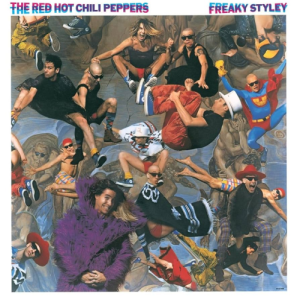
FREAKY STYLEY
| Released: | Rating: | Key tracks: |
| Aug 1985 | 7 | "American Ghost Dance", "Nevermind", "Yertle the Turtle" |
1) Jungle Man; 2) Hollywood; 3) American Ghost Dance; 4) If You Want Me to Stay; 5) Nevermind; 6) Freaky Styley; 7) Blackeyed Blonde; 8) The Brothers Cup; 9) Battle Ship; 10) Lovin' and Touchin'; 11) Catholic School Girls Rule; 12) Sex Rap; 13) Thirty Dirty Birds; 14) Yertle the Turtle
The funk's funkier and the punk's punkier, and scattershot as it is the young Peppers prove their charms as they get a second start.
Jack Sherman's days in the Red Hot Chili Peppers were numbered to begin with but his fate was sealed the very moment that Hillel Slovak was expressing doubts about his future in What Is This and started to reconsider joining his friends over in the Peppers gang. But, before Kiedis and Flea had the chance to unceremoniously kick him out in a manner which makes you feel even more sorry for the guy, Sherman ended up altering the course of the entire good ship RHCP by introducing his bandmates to Parliament Funkadelic. Early Peppers had been equal parts funk and punk but somehow George Clinton's genre-defining project had completely missed them, and discovering them was a damn near religious revelation for Kiedis and Flea. So much so that after Sherman had gotten the boot, Slovak had reunited with his besties and it was time to start recording album #2, the band suggested Clinton should produce it. To everyone's surprise Clinton actually agreed, and not just that but he invited the entire band to live with him for a good month before the sessions began in order to build some chemistry and work on the material. The Chili Peppers' second album was already off to a much better start than their debut.
Freaky Styley acts as a soft reboot for the still-young band - a second chance at a debut, if you will. Everything is simply clicking together much better this time around. The band was back in good spirits now that Slovak was back and Clinton not only proved to be a much more supportive producer who saw the band's vision, but he took on a guiding father figure presence throughout his time together with the gang and nudged them towards decisions he felt the band would benefit from without sacrificing creative control. Clinton's production touch captures the Peppers in a lot more natural environment, jamming together in the same room and emphasising their natural talent in locking into grooves and finding a funky foot-tapping rhythm, and he encourages and emphasises that side of the band to the point that this is probably the Peppers' funkiest album. This is also where Martinez really shows what he's made out of, as his natural style slots so perfectly into these slippier grooves that this album makes a strong case of him having been the funkiest Pepper to have ever drummed on one of their albums. The naughty punk boys side of the band is allowed to co-exist as well and a number of songs that were axed from the debut due to creative disagreements with Andy Gill (e.g. "Nevermind") have been given a thumbs up from Clinton, and you can tell which ones they are because of all the high-speed thrashing around and unchained chaos some of the songs exude (sometimes to their benefit and other times not). The arrangements overall regardless of the nature of the songs are richer courtesy of Clinton's court of session musicians eager to lend backing vocals, percussion and most prominently horn sections behind the band, but the Peppers' own identity is retained, for most parts. The main exceptions there are the two covers of The Meters' "Africa" (now rebranded as "Hollywood" to suit the Peppers better as they sing about their brotherland) and Sly & the Family Stone's "If You Want Me to Stay"; both are extremely slick, smooth and all-around pretty good performances, but perhaps a bit too reverent to the originals in a way that leaves them sounding a little sterile - I can only imagine it's because of the pressure of recording these in the company of Clinton who gave them the idea to begin with. They sound like an like an extended thank you to Clinton rather than something the band would have thought to put on the album by themselves - but given they're decent covers, it's a small price to pay for the Peppers otherwise getting to let loose in their own way across the record.
Because that's what Freaky Styley boils down to. The band sound like they're genuinely having the time of their lives and it results in a lot of excellent energy displayed across the album, where the lack of focus and novice songwriting are comfortably disguised by a lot of charismatic bouncing around. A good amount of Freaky Styley is admittedly stupid - there's a number of one-note joke tracks including two completely superfluous pint-sized interludes featuring largely just Kiedis rhyming ("Thirty Dirty Birds", "Lovin' and Touchin'"), and some songs basically boil down to Flea slapping his bass as fast as he can with little other musical lead while Kiedis spits indecipherable lyrics as he tries to keep pace. You can observe the duality of the contents by considering how within a spitting distance you have "Yertle the Turtle" which recites a Dr Seuss poem over a lazily funky and deliciously slinky groove and becomes a nigh-psychedelically surreal lounge jam as a result, and a punk song called "Catholic School Girls Rule" which is precisely about what it says on the tin and is all braindead punk. Stupid isn't necessarily bad though. "Nevermind", a real airheaded funk-punk blaster, basically boils down to him taking run-and-gun shots at popular pop groups of the time and telling you to stop paying attention to them because here comes the "REEED HAAAWWWWT! CHILIIIII! PEPP-PAAAAAAAAHHS!!!!" - and it's so naïve, dumb and incredible at the same time that I kind of love it, and with that bulldozing bravado who couldn't? Young Kiedis is the master of stupid nonsense as a lyricist, and his bursts of blunt and occasionally dodgy, objectifying horniness which left me indifferent when I was younger now now raise a rather concerned and questioning eyebrow as I hear them as a grown man; but then, he's so in love with his own smack talk that I can't help but be charmed by him as the ultimate party DJ of this raucous wild bunch. Kiedis wouldn't stay afloat without the band's tight interplay around him and that's where the more straightforward rock cuts in particular draw their power, from the battering ram-like "Battle Ship" to the slapfest "Blackeyed Blonde". Even "Catholic School Girls Rule", if you can get past the lyrics (I don't blame you if you can't), genuinely slaps as a piece of pure music to the extent that I really wish it had a different set of lyrics ("Sex Rap", meanwhile, probably could have been left as an early demo and no one would have missed it). The best part of the debut album was the Peppers' natural charisma shining through even when (and some might say especially when) the material was goofy, and Freaky Styley shows how much that spirit can genuinely count for when everyone involved is earnestly having a good time.
But in-between the goofing-off, Freaky Styley also shows that the Peppers are starting to figure out how to write songs as well. "Jungle Man", "American Ghost Dance" and "The Brothers Cup" harness the group's feral energy into some actual choruses and structures that point the way towards a more coherent vision. "American Ghost Dance" might just be the Peppers' first genuinely great song: the emphasised rhythm of its verses is almost prowling in nature, exercising finesse and atmosphere that hasn't really been a thing for Peppers yet, before the chorus explodes into a hook that's simple but in a way that sounds intentionally so and lets the musical accompaniment breathe, rather than it just boiling down to no one being able to think of anything more complicated. It sounds excellent and engaging in a different manner than anything the Peppers have written before. "Jungle Man" and "The Brothers Cup" similarly bear the mark of the band learning how to harness their skillset and personality into more refined compositions; not miles away from the debut, but a clear step forward and a visible bridge towards the future. Even just their funk jams are growing up, as the title track is literally just a three and a half minute loop of the same pattern over and over again but everyone sounds so locked-in and borderline serious about their part in the hypnotic repetition that it's clear they are beginning to form a tight kinship of musicians and not just friends who happen to be in a band together.
So, on one hand, the Peppers are growing up and Freaky Styley gives them the "introduction" that they deserve, linking more naturally to the rest of their discography to come than the debut ever has. On the other hand, they are still a band for whom partying and having a laugh comes first before the actual music and you can absolutely tell from the song material here, where most tracks live on good vibes more than they do through strong melodies. Freaky Styley is by no means a great album no matter how much nostalgic bias one might have for it, and it can be very thankful that its weakest songs and purest fillers are also its shortest tracks so the flaws can be brushed off easier. The next two albums are the ideal version of what prehistoric RHCP stood for and Freaky Styley bears all the signs of a transitional album, of a band learning their craft under the tutelage of someone who had the patience for them and managed to teach their stubborn heads a trick or two. But also - I really like this at the same time. Early RHCP comes with some very specific caveats for new listeners in particular given how much they've changed over the years, and I think there's a particular simple charm to their aggressively exuberant funk rock and the pure energy contained in it that still makes it a worthwhile period to dip into from time to time. That said, I admittedly have zero idea what this would sound like for fresh ears because these songs are so ingrained to my memory that I can't even remember how they sounded brand new. It should be clear by now that this era of the band has other, separate caveats just for myself and all these years later, this oft-boneheaded feel-good mucking-about still has a shocking amount of lasting power. There's a very primal magnetism to Freaky Styley, maybe one only audible for those who are positively attuned towards the base concept of funk and rock holding hands in the first place, but nonetheless one that continues to entertain. There are no further depths here beyond that, but for a good dumb time these are your guys.
Physically: My copy is another turn-of-the-90s issue so again we have a very standard jewel case with a barebones CD design and a completely empty booklet - at least this time around you've got the members' names and the producer credit included. The only thing a little more special about this is the red spine and tray, adding a splash of unexpected colour.
[Reviewed: 06/06/2026]

THE UPLIFT MOFO PARTY PLAN
| Released: | Rating: | Key tracks: |
| Sep 1987 | 8 | "Fight Like a Brave", "Backwoods", "Behind the Sun" |
1) Fight Like a Brave; 2) Funky Crime; 3) Me & My Friends; 4) Backwoods; 5) Skinny Sweaty Man; 6) Behind the Sun; 7) Subterranean Homesick Blues; 8) Special Secret Song Inside; 9) No Chump Love Sucker; 10) Walkin' on Down the Road; 11) Love Trilogy; 12) Organic Anti Beat-Box Band
The original line-up finally reunites and shows just what they're made of, while sneaking in an enthusiastic creative leap.
It's the third album for the Peppers, and it's also their third line-up shuffle. This time things were a little more mutual though. While Martinez enjoyed playing with the rest of the gang he was starting to feel a little burned out and thinking about doing something different; the other three, however, had noticed the reducing motivation and before Martinez had the chance to dismiss himself the rest of the band asked him to leave (they're cool though - Martinez would later on fully agree it was the right call). But Kiedis, Flea and Slovak had other motives for the change in the drummer's seat as well - Jack Irons had recently found himself at the end of his tenure with What Is This and itched to return to play with his friends, and so space had to be cleared. This means that the Chili Peppers' third album finally features the actual, original Chili Peppers as they had formed back in the early 1980s, earning the quartet yet another chance at a new start in a tragicomical manner.
Spurred on by a chance meeting the band hooked up with the young Michael Beinhorn as the producer for the album, who had a clear objective for The Uplift Mofo Party Plan. He had been convinced by the band through watching them perform live but found that neither of their previous two albums had captured the energy and strength the band showcased while on stage. So, he set out to do so - and he succeeds. The Uplift Mofo Party Plan signals right from the start that it's meant to be played just as loud as the band themselves are. It's a lot more rock-oriented and dynamic than the first couple of albums too, emphasising the sheer muscle of the band as Irons' more hard-hitting style finds a good spot next to Flea's basswork and Slovak is given the musical environment to play his riffs harder and rowdier than the slim funk scratches of Freaky Styley. For the first time in studio the Peppers sound like the kind of natural rock and roll force that made them such a presence on live stages, even with some of the inescapable 80s-isms creeping into the production. But Beinhorn and his direction is just one part of that formula for a beefier sound; just as important is the simple fact that we have the original four members reunited at last. Peppers began as equal parts funk and punk after all but the latter had only been allowed to sneakily creep into the first couple of albums, but now that the original four friends are back together and they're calling the shots means that the original vision is allowed to come through completely uncompromised. The Uplift Mofo Party Plan rocks hard and it's because the songs are built that way: how the punkier songs like "Skinny Sweaty Man", "No Chump Love Sucker", and canon-iconic BFF anthem "Me & My Friends" have real sweat on their brow and fire in their belly, the earnestly anthemic choruses to "Fight Like a Brave" and "Organic Anti-Beat Box Band" pack a resonantly powerful kick to them, and when "Love Trilogy" accelerates towards its untethered all-out finale the gang sounds more dangerous than they've ever managed to present themselves as. This is, arguably, what the Peppers should have sounded like from the beginning, had circumstances not gotten in the way.
The rowdy energy isn't the only thing that the band have pulled up on display on Uplift Mofo (sorry, I know I typically type out the full names of albums but I just can't be bothered here every time...) - they've also brought proof that they've grown as songwriters. The debut album was more bravado than musicianship and Freaky Styley was clearly built from jam sessions for most parts, but here you get the feel like the band actually sat down to think what to do with some of these songs. There's an increased focus on melody and some distinct thought put around how the songs are structured, and they've hit the realisation that you don't need to go all-in 100% of the time when sometimes less is more. The clearest example is "Behind the Sun", which you could argue is RHCP's first attempt at something more graceful (if you stretch the definition of "graceful" reaaaaally thin); it's more evocative, slower-going and thoughtful, at the very least. It's a beached-out summer holiday zone-out track basking on gentle psychedelia, complete with some exotic sitar and Kiedis going full hippie mode in his lyrics just to drive in that point, and though the vibe is more pool party than it is confessional it's the most gentle and heartfelt the Peppers have come across so far. It's also a lushly arranged and thoroughly lovely song as well as the album's undeniable heart, showing the start of something new and different for the band to build upon even if they don't quite repeat it again on this album. But you can still hear that same increased seriousness towards the craft throughout the record, from the genuinely hit-angling approaches of "Fight Like a Brave" and "Backwoods" which have a finesse to general flow that simply wasn't there just a couple of years ago, to the casually strolling "Walkin' on Down the Road" where the band's energy briefly taps into something that sounds like a vintage rock radio staple, just a bit Peppered up. Even Kiedis shows growth in his department, not wanting to be left behind by the musicians: the rapid-fire rhyming schemes of "Fight Like a Brave" are genuinely fun, witty and sharp old-school rap lyricism and something like "Backwoods", which was inspired by an awkward meeting with Malcolm McLaren and his insistence that the Peppers should become a 50s rockabilly throwback act, is a demonstration that he's starting to become inspired to write more observationally about themes beyond partying, friends and sex. It's like getting the old gang back together has resulted in bringing the best out of everyone, while at the same time their disparate experiences of the past few years have all taught them new things to bring to the table as Beinhorn is pushing them to take bigger leaps.
Besides all that change and evolution, Uplift Mofo is also just a consistently, thrillingly fun album - which I think matters a fair bit given despite the cautious steps towards wider horizons, RHCP are still a party band at this stage and a party band that doesn't radiate fun is no party band at all. It is still the aspect of the album that appeals to me the most as well just as it did when I was a young and fun teenager, even if now I try to be to smartypants-intellectual about it in my old and weary age, because these guys are just so damn engaging about it. It's a stupid album too but this time it feels more knowingly so, without ever letting it get the best of them: so, "Funky Crime" leans in on its ridiculous audaciousness (which you would expect from a song with that title from this band) between Kiedis' vocal theatrics, ad lib silliness and the band's OTT funk slink to back it all up, and it's all the better for it. On "Skinny Sweaty Man" the band quite literally turn into cartoons as Kiedis goes through his box of voice impressions and at one point fronting a choir of chipmunks, transforming this minute-long bundle of incoherent noise-making into a colourfully giddy burst of excitement. They manage to transcend the carnal crassness of "Special Secret Song Inside" (the title has been censored for a reason) through genuine charisma and a fist-bumpingly good chorus groove so infectious that you completely blank out on what the lyrical hook actually is; they even manage to make Bob Dylan sound exciting (and excited) as they take on "Subterranean Homesick Blues" and add a slick 80s hip-hop swing underneath, and with that as well as the addition of a simple chorus and some talkbox acrobatics they establish the definitive version of the song. "Organic Anti-Beat Box Band" is one of the band's many songs about who they are and what they are all about, but they've never sounded this proud about it and it sounds like a celebration - the overdubbed party sounds add a very fitting ambience over the song, making you feel like you're pogoing in someone's living room huddled up with several other people having the best night of your life.
So you've got excellent energy, improved song material and a great feel-good atmosphere already, but there is lots of wholly subjective context to all this, naturally. This was one of the first Peppers albums I bought after getting into the band (through luck of the draw and what was available at the store more than anything planned) and so I attached to it deeply from an early stage. The main visual that still comes to my mind when listening to this album is my bedroom at the time and how the sunrays beamed through the big windows as I blasted this out loud during the summer holidays. Uplift Mofo is very much a summer vibe album for me and the laidback, have-fun, life-is-a-party tone it's got has made it sound and feel like those perfect, care-free afternoons when life feels like it's the best it can be. You would think that would be enough bias to inch the score up a tad higher but Uplift Mofo is still a little rough around the edges, both in a manner that actually adds to its magic and personality but also in the way that I can't allow myself to become completely devoted to it: if anything, that rose-tinted hue helps brush off how e.g. "No Chump Love Sucker" probably isn't a song anyone would ever remember to bring up in a RHCP discussion for a reason. But even with the little dinks in its armour that it might have, this is the Peppers' first earnestly great album and a genuinely important milestone for them. Not only does it feature the four original members who finally get the chance to immortalise themselves on record and gives you a glimpse of what could have been had they approached the debut this way, but Uplift Mofo is also pivotal in their growth as a band. The line-up would shake again soon afterwards in a more tragic set of circumstances, but Kiedis and Flea held tight onto the lessons learned here. The freshness of those lessons, the tightness of the band's operation and the genuine chemistry of the four people at the heart of it makes this the Peppers' only 80s album that can honestly stand next to their future big-hitters and not be completely overshadowed by them.
Physically: So we've got some actual liner notes finally! My issue is still a classic early CD-era release in its black tray and undecorated disc design, but the front booklet folds out into a small poster featuring all the lyrics (apart from "Special Secret Song Inside" and "Love Trilogy" - too spicy!), credits and band photos, laid out in a fun and chaotic fashion that befits the busy cover image even if the inner design is all simple black-on-white.

MOTHER'S MILK
| Released: | Rating: | Key tracks: |
| Aug 1989 | 7 | "Higher Ground", "Knock Me Down", "Taste the Pain" |
1) Good Time Boys; 2) Higher Ground; 3) Subway to Venus; 4) Magic Johnson; 5) Nobody Weird Like Me; 6) Knock Me Down; 7) Taste the Pain; 8) Stone Cold Bush; 9) Fire; 10) Pretty Little Ditty; 11) Punk Rock Classic; 12) Sexy Mexican Maid; 13) Johnny, Kick a Hole in the Sky
Like a phoenix, the band rises gloriously after tragedy, the iconic line-up making their entrance with an inconsistent but impressive record.
Hillel Slovak's death to an overdose in June 1988 is the keystone event in the Chili Peppers' story that changed the course of their history forever. The tragic loss of Slovak - a slip-up after a period of attempted but ultimately failed sobriety - caused Irons to suffer a severe mental health breakdown which meant he left the band as well. On the flipside, for Kiedis the death of his heterosexual soulmate might have indirectly saved his own life, as at the time he was a lot more reckless with drugs than Hillel had been and whose survivor's guilt scared him straight - he'd swear off drugs from hereon in, bar one unfortunate temporary relapse. While Slovak's death would cause a hole in both Kiedis and Flea's hearts that would never heal, the effects of which would be felt for the rest of the band's life, after a period of grief both men realised they wanted to continue playing music (and in some ways, had to continue given EMI's insistence on them not breaking their contract). The most fateful impact of this whole tragedy would be how this forced period of change opened the way for messiers John Frusciante and Chad Smith to join the band.
Smith, picked from a group of blind auditions, was a powerhouse drummer who wielded all of the groove of funk, the primal strength of hard rock and the technical mastery to spar and weave with the rest of the band's instrumentalists to encourage everyone to step up to a new level. With him Peppers inherited a fiercely tight and powerful backbone the kind of which their previous (while still talented) drummers didn't have. Michael Beinhorn returned as the producer for the album and once again arrived with some strong convictions of what the album should achieve, one of them being an obsession with making things heavier - which was a challenge Smith proved to be more than capable to handle (is that a double kick drum I hear on the almost metal-esque "Nobody Weird Like Me"?) and he bears a lot of responsibility for Mother's Milk to sound as dyinamic as does. But the greatest transformation came with the wunderkind John Frusciante, barely over 18 at the time he was recruited to the band. He not only had mad technical chops way beyond his age that could not only perfectly replicate Slovak's style but also go beyond, but he also brought in something that the band's previous guitarists had lacked - an ear for an earnest melody. Great as his guitar playing is, Frusciante's most important contribution to the Peppers was his already considerable talent as a writer and an arranger, which almost overnight expanded the band's musical approach way beyond what they had ever tried before. Everyone in the band credits Frusciante for opening new doors for the group through the Mother's Milk sessions and the album bears that change proudly.
Mother's Milk is a vibrant burst of absolutely everything that was inspiring the band and coursing through their musical veins during that blessed honeymoon period of four new blood brothers finding each other. It covers a massive amount of ground from the band's usual funk rock antics to punk rock and vibrantly melodic moments of genuine prettiness, and the topics in them run through both skin-shedding emotion as Kiedis begins to explore new areas lyrically as well as some dubious horniness. Copious amounts of backing vocals coat most songs, Flea brings out his trumpet for the first time, there's an instrumental, they cover other people with Stevie Wonder's "Higher Ground" and Jimi Hendrix's "Fire" both receiving the Peppers treatment, and the latter is actually a live recording from a few years earlier when Slovak and Irons were still in the band, their frequent setlist cover of choice included as a direct tribute to those who aren't here anymore. In just 13 tracks Mother's Milk goes everywhere and all at once, barely pausing for breath - but it's obvious the messiness stems from it simply being impossible for the band to stop trying new things. Some credit to Beinhorn as well - while he did start to get on the band's nerves so much that they wouldn't work together again, his insistence of playing the songs as many times as possible until the absolutely best take possible was captured does mean that even the songs clearly destined for most people's filler folders turn into something that can excite: the basketball chant "Magic Johnson" (the fleeting moment where each member gets to shout a line is one of the most memorable couple of seconds on the record) and the snotty MTV-snarking minute-long sneer "Punk Rock Classic" really punch way more engagingly than they ought to. Heck, the designated intermission "Pretty Little Ditty" - a 1:36 instrumental - has become one of the album's definining moments given its unexpected moment of serenity does the utmost to highlight Frusciante's style as a guitarist (and I suppose we do have to blame Crazy Town for some of its retrospective fame...).
So, it's a little uneven, as you'd perhaps expect from what is for all intents and purposes a new band (again) coming together for the first time. Really, this album is the start of the Peppers overstuffing their albums with every idea they could think of from now on, and the only thing preventing Mother's Milk from being even moreso is likely just the vinyl space restrictions that they would still have had in their mind in 1989. You could absolutely cut some songs to make for a leaner album that some might even dare call a classic: "Sexy Mexican Maid" and "Stone Cold Bush" approach the same subject from the opposite ends of energy (the former a chilled, smooth suite and the latter full of sweaty bravado) and can on a good day impress a little more, but they're both one-dimensional bits of teenage horniness that stand out of place among everything else here, and though including "Fire" is a lovely touch sentimentally just as a musical piece it's an equally out of place scruffy live cover. Some albums make their sprawling nature a feat of strength and others come across like they awkwardly restart with each song, and Mother's Milk falls in the latter category - if you want to knock the album for points, that's why you'd do it. But talking about its flaws runs the risk of hiding the things it gets right, and it sure does get some things really right.
For one, there's "Knock Me Down" which is the undisputed central pillar of the album which holds everything together. "Knock Me Down" is arguably the most important song the Peppers had made by this point because it represents all the change that had happened, starting from the lyrics and vocal delivery where Kiedis reflects on Hillel and pleads for people to understand that it is not a sign of weakness to ask for help when you need it. Kiedis had never just been a big horndog even early on as much as that was the way he'd often be represented, but "Knock Me Down" adds the element that had been missing from his vocabulary and that's earnest vulnerability; the mixing error that places Frusciante's co-lead vocals almost on top of Kiedis' actually helps convey this, the two men's voice blending into something more distinctly heartfelt as the lyric goes out in unison. The vocals and the feeling are perfectly complemented by Frusciante's composition - still crashing through with that TNT energy they had but pinned down by the strong melody which acts as the song's beating heart and guiding hand, taking it through various ebbs and flows until it reaches the climactic finale that plays out like a bittersweet toast (and "it's so lonely when you don't even know yourself" is rather insightful from Kiedis ca. 1989 too). "Knock Me Down" is the best song that Peppers have written so far and it became such a key part of their evolution, especially when it took off as one of their first genuine hits, previewing the Frusciante-lead eras to come.
"Knock Me Down" is complemented by a handful of more particularly strong compositions - and I use that word very deliberately because how these songs move around the base verse-chorus-verse-chorus-solo-chorus structure is a lot more unpredictable than on the first three albums. "Taste the Pain" acts like a companion to "Knock Me Down" and not just because it follows it directly in the tracklist, but rather because there's a bit more nuance and deftness to its slow jam lurk and expanded instrumentation (trumpet, cello), with the chorus' return to the crowd vocals the album so loves acting as a great bit of contrast; again, just making it obvious that the Peppers had really grown and matured as a songwriting unit. "Good Time Boys" and "Subway to Venus" remind that despite these changes these are still the same band who recorded the first three albums, as the former kicks the album's doors open with another ode to the band themselves but sounding prouder than ever as it struts and rocks with confidence, and the latter is a delirious bit of cosmic feel-good funk where Kiedis puts on his cheekiest charm and wink. Both have whimsy, joie de vivre, legitimately fun breakdowns (a little bit more of a traditional instrumental break in "Subway to Venus", the sudden radio sample interruption in "Good Time Boys") and basically they bring out the best of RHCP in their chosen contexts. And if there's one song that demonstrates the strength of the record's core elements, it's the closer "Johnny, Kick a Hole in the Sky", a five minute verse-chorus loop jam with nothing to break down its repetition but where it's a pure joy to hear those parts being repeated throughout, whether it's Flea's dubadubadubadum bass runs, Smith and Frusciante's tight interplay, Kiedis going on a soap box with a Mission and a Message in his extended rant lyrics, and the fantastic "testify, testify!" backing vocals that add a dash of sudden light into the brief chorus segments. It's a simple, basic song if you boil it down but the band sounds great, Beinhorn's clearer and more dynamic production without any obvious 80s-isms presents them excellently and it's just a joy to hear that tightly locked-in groove. The band's take on "Higher Ground" exemplifies that as well: they transform the song into a half-party half-rebellious rock anthem that sounds like it could have been written by them to begin with, Beinhorn's production approach is perfect for it and all in all it's no wonder it became the band's first hit. In retrospect it may not be one of their stand-out singles any longer, but every time it kicks in on the album you feel a rush come through and the communal crowd vocals in the chorus (with Jack Sherman as one of the many voices!) are a real blast. It's pure, primal rock and roll energy and it works.
Mother's Milk is no doubt an engaging album; it's yet another debut from a band whose back catalogue is full of fresh starts, but this time the sense of transitioning into a new phase is tangibly palpable and there's a breeze of giddy thrill flowing through the record. But that 'transitional' is a key word, as for me the album represents a bridge between two distinct eras of the band. Whilst that middle ground does mix together thrilling aspects from both sides of the border, it as a result lacks a little bit of its own thing. It's an album that represents change brought on by the new hands on board, but everyone is still learning how they work together as they go and there's no doubt that once they got completely accustomed to one another, the results blow this out of the water. So, it's always had that awkward interim feeling for me, so though I have a lot of fond memories of the album - I bought this around or during a trip to visit distant family and I remember browsing the booklet in the guest room bed while playing this through my Discman, and being particularly surprised when "Pretty Little Ditty" came a-knocking in this post-"Butterfly" world - typically I lean towards either of the albums around it if for the stronger doses of their respective Peppers sounds. Though it doesn't quite hang together particularly smoothly, it's undeniable that Mother's Milk is an enormously important album for the band, so much so that you could even earnestly call this a little underrated. But, greater things were waiting just around the corner as the band closed off their 1980s.
Physically: A black-spined jewel case, with a slightly different cover (in my copy the RHCP logo is on the bottom right, but I couldn't find a hi-res version of this for my own uses). The booklet is a relatively straightforward list of lyrics, but it's notable for the back featuring one of Hillel's paintings and a dedication to his memory. It's also one of those albums where the text on the spine goes counter to the usual way these things are designed, so I have to keep the case upside down in my shelf. It's the little things that peeve you.
[Reviewed: 25/07/2026]
OTHER RELEASES

WHAT HITS!?: BEST OF RED HOT CHILI PEPPERS
| Released: | Rating: | Key tracks: |
| Sep 1992 | 8 | "Show Me Your Soul"... it's the only "new" one! |
1) Higher Ground; 2) Fight Like a Brave; 3) Behind the Sun; 4) Me & My Friends; 5) Backwoods; 6) True Men Don't Kill Coyotes; 7) Fire; 8) Get Up and Jump; 9) Knock Me Down; 10) Under the Bridge; 11) Show Me Your Soul; 12) If You Want Me to Stay; 13) Hollywood (Africa); 14) Jungle Man; 15) The Brothers Cup; 16) Taste the Pain; 17) Catholic School Girls Rule; 18) Johnny, Kick a Hole in the Sky
If you just want a summary of the EMI years, this does the job pretty well. Oh and there's also "Under the Bridge".
Mother's Milk had been the Chili Peppers' breakthrough album and had become a genuine hit, but after the tour and promotional duties had wound down, the band and their team all shared the same thought: it could have been an even bigger hit. The relationship between EMI and the band had never been particularly great and though EMI had put some effort into Mother's Milk that helped it become successful, they had only bothered promoting it in the US - when the Peppers toured Europe they were practically unknown and the contrast felt even starker now than it had before. At the same time other labels were starting to get interested in signing the group, especially as the word got out that they weren't particularly happy about continuing under EMI, and eventually Warner Bros attracted their attention. The problem is that they still had three albums left in their contract with EMI so they couldn't just exit. But Warner put their money where their mouth is and settled a deal with EMI to allow the band to exit early in exchange for cold hard cash and a couple of other conditions. One of these was that EMI negotiated the right to choose one song from the band's first album with Warner to include in a future compilation.
And that, my friends, is the answer to the frequently asked question of why on earth is "Under the Bridge" on this compilation.
As for the rest of this compilation that EMI released fairly soon after Blood Sugar Sex Magik had become a global mega smash, the self-snarking title is very accurate given under EMI's wing the band only ever had two real hits ("Higher Ground" and "Knock Me Down"). The rest of What Hits!?, then, is made up of what an average person would consider the easy picks for the créme de la créme of RHCP's first four albums of manic funk rock. All the singles are accounted for, as are all the songs that weren't explicitly singles but had videos made for promotional purposes - so everything that someone could have feasily heard in the radio or seen on MTV at some point. The rest of the tracklist is rounded up by a bunch of album tracks that you can easily agree with: "Me & My Friends" is arguably survived as the most iconic song of the band's 80s in their personal canon (and still gets played live today), "Behind the Sun" was everyone's highlight of The Uplift Mofo Party Plan and was finally released as a promotional single for this compilation after being denied such treatment by EMI back in 1987, "Fire" was played live all the time during the band's early shows and it opened the UK-only The Abbey Road EP so reasonably could have been familiar to some, "The Brothers Cup" has its place in the band's mythos by referencing the injoke antics that Kiedis and Flea tried to make into a thing in the early days, etc. There's a couple of more intriguing picks like choosing "Johnny, Kick a Hole in the Sky" out of all the remaining tracks on Mother's Milk after the singles (I'm not complaining, I love the song, but it's a weird pick), and the cover of "If You Want Me to Stay" is presumably only here because it's a cover of a song you likely recognise rather than because it's in any way an essential part of the band's history. For all intents and purposes it's a good selection and the songs are split decently equally across the albums, even if the debut gets the short straw with just two songs - if you only ever wanted to own one album to represent the band's 1980s period in your shelf, it'd be difficult to argue that this doesn't act as a strong summary of the early years.
The obligatory bait to hook in established fans is the inclusion of "Show Me Your Soul", which was originally featured on the Pretty Woman soundtrack and even planned as a single before its release was abruptly cancelled (they even had the time to make a video for it), marking this the only Peppers album where you can find it. The catch is that it's actually quite brilliant, and that makes it a genuine catch for the fans. "Show Me Your Soul" is a direct continuation of the more polished dynamics of Mother's Milk and there's so much to love and to sweep you away with in it. The verses have such a sweet charm to them, it's loaded with fun details from the gliding piano to the brightly pecking cowbell and a bonafide organ solo, Kiedis' vocal performance is colourfully exuberant, and there's even a great little bit of a hollering sing-along section to boot. It honestly could have been a hit in its own right had it been released and it's easily one of the best of the best of.
The biggest problem What Hits!? has is, well, "Under the Bridge". I get why it's there - but it really ought not to be because it comes from such a different world than the rest of these songs. I get that EMI weren't giving a rat's ass about concepts like "cohesiveness" or "artistic consistency", but as incredible as song as it is and as much as the label tried to wedge it comfortably into the album by placing it in-between the similarly more nuanced and polished "Knock Me Down" and "Show Me Your Soul", it just completely throws you off the album's tracks. "Give It Away" was right there, also a gigantic hit and would've worked much better! Even outside "Under the Bridge" the compilation generally flows rather awkwardly, because even though all the rest of these songs come from a reasonably short time frame and the relative same place in their mindset, the transitions somehow stick out each time. It's a minor complaint, but it's enough to have made me wonder why this generally well put-together tracklist just doesn't quite have the impact it ought to do.
But in short, for such an obvious cash-in compilation (there aren't even any real liner notes), What Hits!? does the job pretty well, even in this day and age. The casual fan looking for the big hits isn't going to be interested - mainly because, uh, what hits, and they've got the 2003 compilation of actual hits to attract them anyway. But the collector? "Show Me Your Soul" is made easily available. The curious listener intrigued about the group's early days? This could be an excellent gateway. Someone who's a fan already but who's got a craving desire to take a patchy era and tidy it up into a tight collection of fun, bouncy funk rock that's great to play whenever there's a want to hear a solid stream of the stuff? It's right here. The title isn't wrong, but the selection is sometimes strong enough to almost make you believe that some of these could have been hits.
Physically: The picture above - the album's more famous sleeve - is actually the inner booklet design; the copy I have also has an o-card, which bears a different design of four white socks neatly in a row (just to reference that one once-infamous trick). As mentioned the booklet is pretty bare with no commentary or liner notes, just song credits and various promo photos of all the different members who contributed to the first four albums - except for Jack Sherman, who's been completely erased from existence. I get that they didn't get along at the time, but I still find that a bit rude.
[Reviewed: 28/07/2026]

OUT IN L.A.
| Released: | Rating: | Key tracks: |
| Nov 1994 | 5 | "Out in L.A. (Demo Version)", "Blues for Meister", "What It Is" |
1) Higher Ground (12" Vocal Mix); 2) Hollywood (Africa) (Extended Dance Mix); 3) If You Want Me to Stay (Pink Mustang Mix); 4) Behind the Sun (Ben Grosse Remix); 5) Castles Made of Sand (Live); 6) Special Secret Song Inside (Live); 7) F.U. (Live); 8) Get Up and Jump (Demo Version); 9) Out in L.A. (Demo Version); 10) Green Heaven (Demo Version); 11) Police Helicopter (Demo Version); 12) Nevermind (Demo Version); 13) Sex Rap (Demo Version); 14) Blues for Meister; 15) You Always Sing the Same; 16) Stranded; 17) Flea Fly; 18) What It Is; 19) Deck the Halls
Vault clearing to cash in, with not much of anything worth actual interest in the said vault.
EMI were keen to get some extra cash in their pockets after the Peppers had suddenly blown up worldwide immediately after their exit from the label, and a couple of years after the cash-in compilation What Hits!? the label started clearing the vaults for a second round. By 1994 it was becoming commonplace for bands to build a reputation through the off-cuts they'd leave as single b-sides, so a selection of odds, sods and discards wasn't the wildest idea out there; the problem EMI faced is that RHCP only started to really release unique studio cuts as b-sides after they left the label and they weren't exactly productive outside their albums in general. To their credit EMI do seem to have put some amount of effort into pulling together a reasonable set of rarities from what they could find. But when what you're working with isn't exactly worth a shout to start with, you're bound for an underwhelming trip.
Out in L.A. is neatly grouped into sections and it starts off with the more imminently presentable material of the lot, i.e. some remixes - at least these had some weight (and production quality) under them. It's an alright start: the 12" mix of "Higher Ground" adds a very late 80s hip-hop beat to the song and extends some of the instrumental breaks, with a few brand new rap lines from Kiedis thrown in for good measure, and the extended mix of "Hollywood (Africa)" is exactly what it says on the label and simply lengthens the original song by a couple of minutes to give it a more locked-in, jam-like groove quality. Neither are versions that you'd ever reach out for specifically, but they have their own debatable positives and certainly do a better job than the other two remixes. The Pink Mustang mix of "If You Want Me to Stay" (third remix of a cover in a row!) takes way too long to get a point where something interesting happens, i.e. when the rather unexciting dance beat segues into a segment of the original song before pulling back again, and the Ben Grosse version of "Behind the Sun" is 1:1 with the original outside making the instruments sound a lot more overproduced, and it leaves an impression of simply being unnecessary. After the four remixes comes the live section of the compilation, all captured during the 1989 tour, which continues with the covers by way of a decent if slightly ropey version of Jimi Hendrix's "Castles Made of Sand" and the very brief Thelonius Monk loan "F.U." which during a live set would be a nice enough intermission, but on an album like this strikes as desperation to find anything to fill the disc. They bookend a live rendition of "Special Secret Song Inside" which is... pretty fine actually, with plenty of the band's energy coming through. Though the song itself may be somewhat dodgy from a contemporary perspective the recording here demonstrates how easy it was for this band at this time to sell it just through their sheer performance. It's no hidden gem, but it does lead you to wonder if a full-on live album would've been a better deal.
In any case, we're going to skip a section and go straight to the end, where Out in L.A treats us to a bunch of miscellaneous unreleased songs and non-album cuts that EMI could dig out. This should be the section that grabs the fans' attention the most but the fact that it's been sweeped right to the end, as if to sheepishly hide its offerings from plain sight, is indicative of how this part of the record is a lot less impressive than the number of songs would imply. "You Always Sing the Same", "Stranded" and "Flea Fly" are barely over a minute long put together and they all come from the band's tradition of what they called "campfire songs", quick and juvenile group sing-along intermissions that they'd pull out in-between their songs when they were playing live, and as a listening experience outside that context they're the purest possible filler. "Deck the Halls" closes the album in a similarly throwaway fashion and hearing the band (intentionally) butcher the classic yuletide single for barely a minute is the kind of lackluster conclusion that sours the final impression. They are the very dregs of a vault that wasn't particularly full to begin with and propping them up without anything meatier around them is almost insulting to anyone who was genuinely looking to find something unheard from this compilation. At least you do get the slinky "Blues for Meister" which is an actual, fully-produced studio track with a slick trumpet part to boot, where Flea takes the rare lead vocal duty in tribute to his departed cat; by no means a masterpiece, but downright revelatory when you consider what's next to it (it's also the only place in the RHCP discography where you can hear Dewayne McKnight's drumming during his very brief stint in the band before Smith took over the seat). The other honestly worthwhile archive find of this section is "What It Is", an early demo featuring just Kiedis and Flea: the lyric would split into "Green Heaven" and "The Brothers Cup" eventually while the song overall ultimately went to Nina Hagen (who Kiedis was briefly dating around this time). It's a rough home recording featuring just the bass and Kiedis' voice, but there's something almost heartwarmingly endearing to it - just hearing these two guys who have been the heart of the band for all of their decades-long run, captured on tape in the very beginning of that journey as they're sat in their flat creating music together, and the hooks aren't bad either.
The real jackpot of Out in L.A. and the reason why fans should vaguely consider the thought of getting this lies in the middle of the compilation, and that's the original 1983 demo tape. The band's very first demo is borderline mythological in their lore, with Flea still saying in the 2020s how he thinks it's one of the best things they ever did (I would imagine the memories play a lot larger role there than the music) and how the conversation around their debut album inevitably centers around the failure of not being able to replicate the impact of these demos for various reasons. The demo songs (which technically also include "You Always Sing the Same", "Flea Fly" and "Stranded", but they've been separated into their own section here) aren't going to blow anyone's face off or convert any haters, but they do capture why it is that RHCP created such a buzz when they first appeared as a live tour de force. These early takes, recorded with Slovak and Irons still in tow before label issues forced their hand in leaving the band temporarily, illustrate a group of friends throwing all of themselves into a set of hyperkinetic mish-mashes of funk, punk and rap, which are undeniably rough around the edges but that the four men have absolute and earnest belief in. Though at the end of the day they are museum exhibits rather than anything you'd bring out on a day-to-day listen, they genuinely reveal something new about the source material and leads you to wonder how different things could've been had they been able to bring the same fire to the debut album. "Out in L.A." above all - it was the band's very first song and the reason RHCP turned into a serious project rather than a one-off appearance, and you would never understand why if you only ever heard the limp re-recording that's on the debut album. This demo version here is the song's definitive form and one that accurately displays the flamboyantly feral and freakishly fun power that made it their early calling card. For a RHCP fan these demos are worth hearing just to understand what the big bang sounded like, and they're far and away the most interesting material featured on this compilation.
Aside from that, Out in L.A. offers very little anything essential and even those demos are only of interest to the keenest of historian devotees. Kiedis and Flea may have given their blessing for this project, given their bespoke liner notes which reminisce upon the early days, but very little of what's found in this compilation really deserves to be dragged back under the spotlight. The mad thing is that we know there absolutely would've been far more interesting material to cover: the early 2000s EMI reissues of the albums came with far better bonus tracks (including all those demos), and most bewilderingly there's the complete absence of "Millionaires Against Hunger", the band's one legitimate b-side from these years and an excellent track in its own genuine right that would've easily made this compilation worth picking up all by itself. Doing the whole "what it could have been" what-if scenario isn't a very fair way to judge an album, but you can still acknowledge they had the ingredients to potentially make this a lot more substantial outtake collection. Instead, you have a few songs worth hearing once or twice, a bunch of historical artifacts to remind the hardcores how this whole business began, and a whole bunch of largely ignorable fluff that no one will be either thrilled or bothered by. All signs point out to a sloppy, slapdash, quickly pushed out cash-in taking advantage of a gap in the band's release schedule. And to think that this is me having mellowed down on this slightly over time!
Physically: Standard black-spined jewel case. The booklet features basic information about each song but there's a lot of info that's obviously either missing (recording years for some songs) or even wrong (some track times). What's worth of a minor note are the aforementioned liner notes from Kiedis and Flea who take the opportunity to talk about how the Chili Peppers started and their early years in their own, colourful words.
[Reviewed: 02/08/2026]
CD SINGLES

HIGHER GROUND
| Release date: | A-Side: | B-Sides: |
| Apr 1989 | 8 | 7 (track 3 does a lot of lifting...) |
1) Higher Ground; 2) Higher Ground (Munchkin Mix); 3) Millionaires Against Hunger; 4) Mommy Where's Daddy
The Chili Peppers' first genuine hit single was borrowed material, but the band inject so much of their own DNA into it that you can't say they're just riding on Stevie Wonder's coattails. Wonder may contribute the strong vocal melodies but the rest is all RHCP, and specifically this new powered-up form following the addition of Frusciante and Smith. The song is morphed into a loud, boisterous crowd-cheered call-to-arms that sounds at home both when marching down the streets and when bringing down the house in a raucous party: Flea's exuberant slap bass, Frusciante's half-funk half-hard rock riffage, Smith's muscular backbeat and Kiedis' confident command of the mic all come together to form a Chili Peppers song, that just happens to be a cover. In my review for the album I made a brief mention how in retrospect, with the next couple of decades in mind, "Higher Ground" has lost some of its sheen and status in the band's singles pantheon - but coming back to it is always a blast and it firmly slots itself as one of their few covers that feel essential to their musical story.
For fans, the important part of this single is the appearance of the first ever proper Peppers b-side. "Millionaires Against Hunger" is actually a leftover from the Freaky Styley sessions and it's not only mad that this lay unused for years, but downright incomprehensible how it didn't make that album in the first instance when it's better than half the material that ended up on the record. The irreverent political sneer - a very snarky take on rich people not using their resources for good, a tale as old as time - is narrated wonderfully through a slinky, jaunty funk groove full of bounce and sparkle. The verses have that slightly goofy and cartoony early Chili Pepper charm proudly on display, and even when the chorus gets a little more stompy as the band directly point the fingers at their targets, it retains that jovial party vibe. With the chorus' crowd singalong this slots so perfectly into the world of Mother's Milk that it's really easy to not realise this predates the album by a good couple of years, but in that way makes sense why they'd finally choose to push this out at this point (and, well, probably because this would be the first time people would actually be buying a RHCP single...). It's a great bit of fun and even considering the band's future b-sides, this still stands out in the crowd and makes a case for being one of the essential non-album cuts.
The single is rounded off by the Munchkin mix of "Higher Ground", which is one of the many names for the 12" extended mix that would appear across various releases around this period: it adds a more 80s-style hip hopt beat over the song and extends the instrumental sections in the manner these period mixes typically do; it's okay, the added slap bass theatrics are neat and I like the little nod to "Show Me Your Soul" in the brand new rap interlude from Kiedis, but it'll never find its way into my listening queue outside specifically listening to this release (or Out in L.A.). There's also "Mommy Where's Daddy" lifted straight from the debut, and while I completely understand that before the 1990s repurposed album deep cuts made up most b-sides, I'm mainly just left to wonder why this song out of the debut instead of anything else. The likely reason is because it did stuck around for a while in the band's live sets, including this period - but though the music has some nice loungey suaveness to it, everything else about it just makes me think how there would be so many better songs on the debut to resurface for this purpose. But, you're coming here for "Millionaires Against Hunger", anyway.
Physically: The issue I've got is the UK CD single which was issued in January 1990 - I've left the single's original release date (April 1989) above just for the purposes of a neater timeline. It's a pretty standard single packaging - thin jewel cases, with credits and some more band photos/video stills in the back of the sleeve, nothing inside the sleeve itself.
[Reviewed: 26/07/2026] Back to beginning